Shingo NOZAKI (Graduate School of Science) paper has been accepted for The Astrophysical Journal Letters.
Congratulations!
Authors
Shingo Nozaki and Shu-ichiro Inutsuka
Affiliation
Graduate School of Science, Department of Earth and Planetary Sciences
Manuscript Title
An Origin of Radially Aligned Filaments in Hub-filament Systems
Abstract
Recent observations have identified hub-filament systems (HFSs) as the primary formation sites of massive stars and star clusters. Some HFSs are characterized by multiple filaments aligned radially toward a central high-density hub. However, the physical origin of radially aligned filaments remains unknown. Here, we propose a new formation mechanism of HFSs driven by the interaction of a fast magnetohydrodynamic shock with a molecular cloud characterized by an hourglass-shaped magnetic field and density inhomogeneity. Our three-dimensional magnetohydrodynamic simulations show that the shock propagation leads to the formation of radially aligned filamentary structures with line masses slightly above the thermally critical line mass and lengths of 1–3 pc and widths of 0.06−0.08 pc. High-density filamentary gas selectively exhibits inward velocities of 1–4 km s−1 that increase toward the hub center, while the ambient low-density interfilament gas retains low velocities regardless of the radius. Mass accretion onto the hub is channeled through dense filaments. The filament formation is driven by oblique shocks generated at the bent magnetic field lines. The resulting postshock amplification of the tangential magnetic field induces a magnetically guided inflow. The shock–interface interaction amplifies density perturbations, resembling Richtmyer–Meshkov instability modes, which promotes the fragmentation of the shocked layer into multiple filaments. The process studied in this Letter explains both the morphology of radially aligned filaments and the selective mass accretion observed in HFSs. In our simulation, the resulting star formation efficiency (SFE) is ∼4%, suggesting that the shock-driven evolution limits the SFE to only a few percent.
Journal name
The Astrophysical Journal Letters
Relevant SDGs
SDGs 4(Quality education), SDGs 9(Industry, Innovation, Technology and Infrastructure) ,SDGS 17(Partnerships for the goals)
Comments
I am Shingo Nozaki, a third-year PhD student in the Graduate School of Science. In this study, I performed large-scale three-dimensional magnetohydrodynamic (MHD) simulations to investigate how structures form in regions where stars are born. The results suggest that the radially aligned filamentary structures seen in hub–filament system molecular clouds, a well-known site of massive star and cluster formation, can be produced by the interaction between shock waves and magnetic fields. I also analyze their velocity and magnetic field structures, and discuss how star formation may be affected in such environments. For more details, please see the URL below.
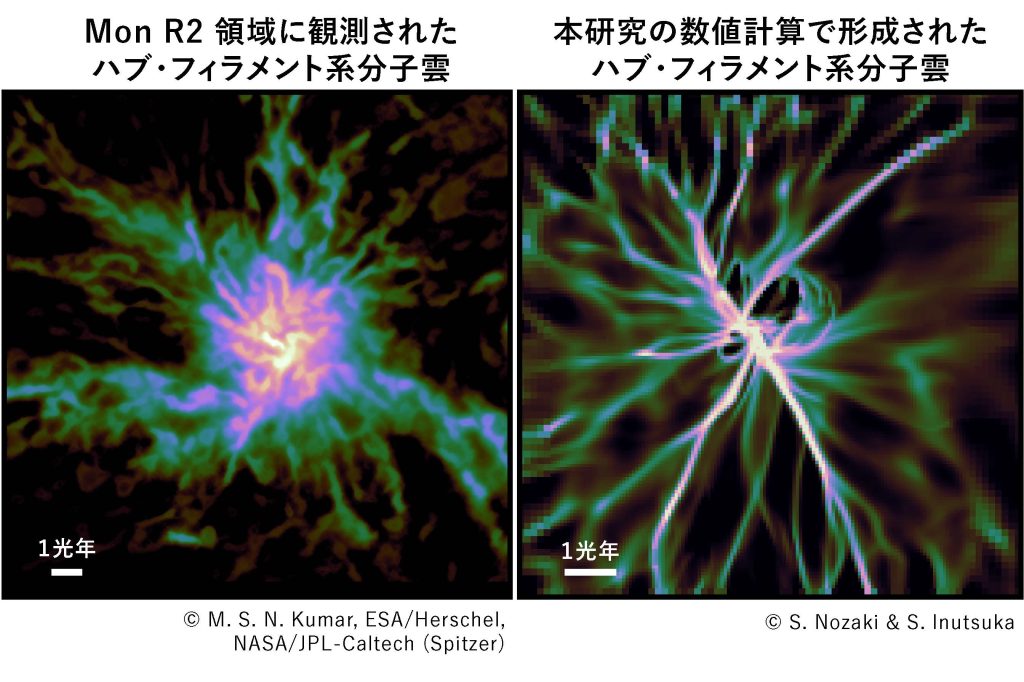
Comparison of observed Hub-filament molecular clouds and structures generated by the simulations in this study.
The left panel shows an observed hub-filament molecular cloud, while the right panel shows a structure generated by the three-dimensional magnetohydrodynamic numerical simulations in this study. Both exhibit the characteristic feature of multiple elongated gas structures (filaments) extending radially toward a central high-density region. This study demonstrated that such characteristic structures can form when high-speed interstellar shock waves interact with molecular clouds possessing curved magnetic fields.