Kaito Sasaki’s (Graduate School of Engineering) paper has been accepted for the Journal of Porphyrins and Phthalocyanines.
Congratulations!
Authors
Kaito Sasaki, Keita Shichijo, Youichi Mihara, Hiroshi Ito, Yui Zennyoji, Nao Imai, HIsashi Shimakoshi
Affiliation
Graduate School of Engineering, Department of Applied Chemistry
Manuscript Title
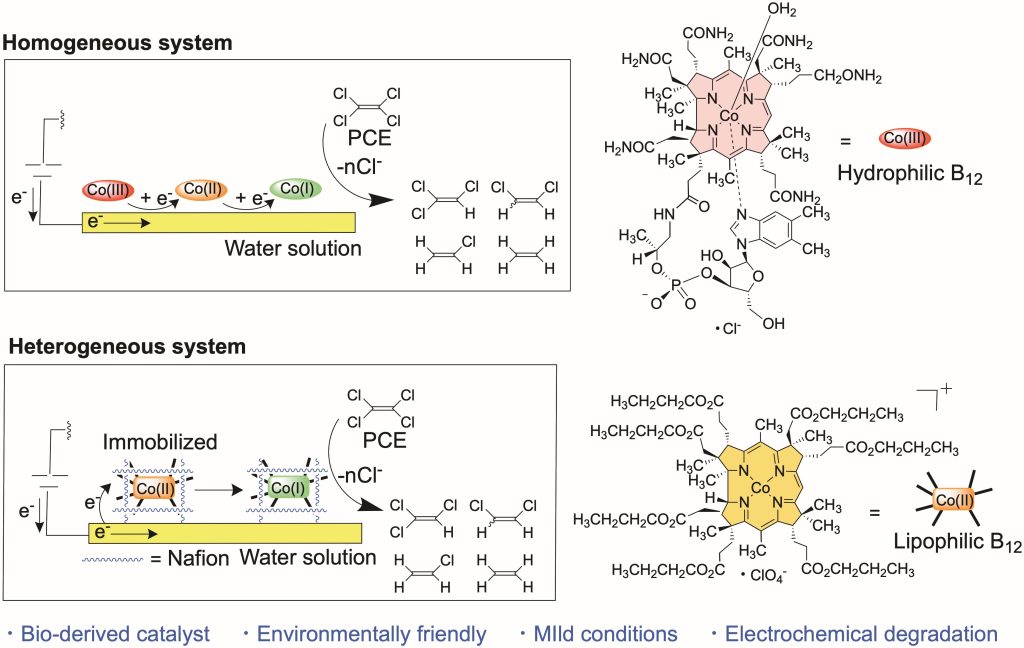
Electrochemical dechlorination of PCE catalyzed by B12 in homogeneous and heterogeneous systems
Abstract
Electrochemical dechlorination of harmful perchloroethylene by the homogeneousaquacobalamin (vitamin B12a) system and heterogeneous lipophilic B12 modified electrode system in neutralto alkaline water under aerobic conditions by controlled-current electrolysis were reported. Aquacobalamineffectively catalyzed the dechlorination of perchloroethylene, converting it into trichloroethylene,dichloroethylene (cis/trans), vinyl chloride and ethylene in neutral to alkaline water. The lipophilic B12derivative with peripheral propyl ester modification was immobilized with Nafion®︎ membrane on a carbonelectrode by a spin coating method and characterized by SEM-EDX, 3D laser scanning microscopy andcyclic voltammogram analysis. The B12 modified electrode with a high water durability catalyzed thedechlorination of perchloroethylene in alkaline water, effectively affording the correspondingdechlorinated products, trichloroethylene, dichloroethylenes, etc., with the 152 turnover number. Theelectrolysis of perchloroethylene in a D2O solvent instead of the H2O solvent and in the presence of N,N-dimethylformamide-d7 as a hydrogen radical source in standard alkaline water indicated the involvementof a protonation process for dechlorinated product formation during the electrolysis.
Journal name
Journal of Porphyrins and Phthalocyanines
Comments
We have submitted the results of our joint research with Tokyu Construction Co., Ltd. to an international journal. By using vitamin B12, an essential nutrient for human life, as a catalyst and constructing a new electrochemical reaction system driven by clean electrical energy, we have successfully decomposed perchloroethylene (PCE), a substance causing groundwater contamination worldwide, in an environmentally friendly and rapid manner. Going forward, we plan to conduct purification tests at actual groundwater contamination sites and work toward practical implementation in society.