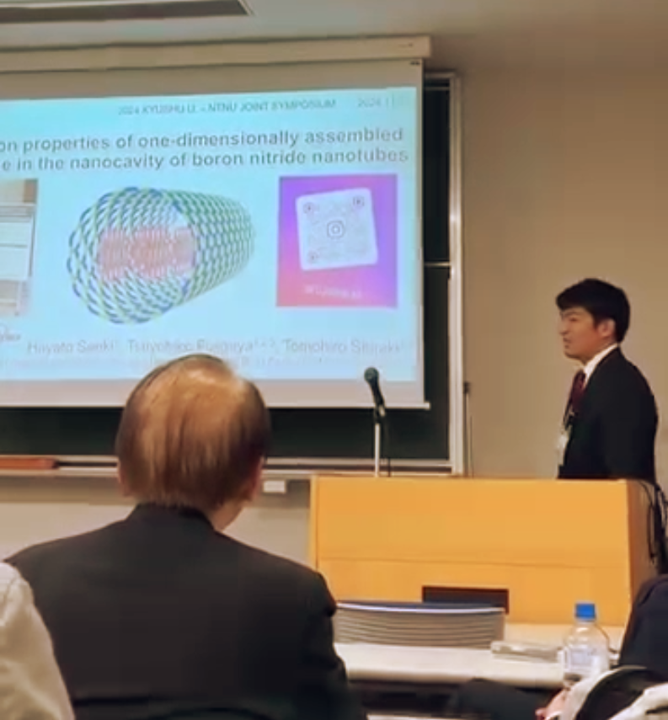
Hayato Saeki (Graduate School of Engineering) paper has been accepted for The Journal of Physical Chemistry Letters.
Congratulations!
Authors
Hayato Saeki, Takumi Ehara, Kiyoshi Miyata, Toshikazu Ono, Satoru Emoto, Hiroki Ago, Aki Masaoka, Yoichi Sasaki, Koji Harano, Koji Kimoto, Tsuyohiko Fujigaya, Tomohiro Shiraki
Affiliation
Graduate School of Engineering, Department of Applied Chemistry
Manuscript Title
Tetracene Inclusion in Boron Nitride Nanotubes for Photoluminescence Property Modulation Based on Aggregated State Control in Their Nanocavity
Abstract
Boron nitride nanotubes (BNNTs) are used for the self-assembly of tetracene (Tc) molecules without chemical modification in their one-dimensional nanocavities. The Tc aggregated state can be changed depending on the encapsulated Tc amount that is controlled by the sublimation conditions of Tc molecules for the complexation (Tc@BNNTs). As a result, the photophysical processes, including singlet fission in the Tc assemblies, are varied, which enables the emission mode switching of the aggregation-based fluorescence and the excimer emission for Tc@BNNTs. Consequently, the host–guest complexation using BNNTs allows not only the fabrication and evaluation of optically functionalized molecular assemblies in the nanocavity but also the modulation of their photophysical processes, by which the emission colors of Tc@BNNTs are also tuned.
Journal name
The Journal of Physical Chemistry Letters
Relevant SDGs
SDGs 7(Affordable and Clean Energy)
SDGs 9(Industry, Innovation, Technology and Infrastructure)
Comments
Nanotubes have cavities on the nanometer scale (1 nanometer = one millionth of 1 millimeter). Since molecules are also on the nanometer scale, in the nanocavity of BNNTs, it is possible to accumulate molecules in a different orientation compared to that of the crystal state. BNNTs are transparent from visible to near infrared wavelength region, and the optical properties of molecules, which were encapsulated in BNNT cavities, have already been evaluated by other research groups. Therefore, I proceeded with the research in this paper using a unique approach of accumulating molecules in BNNT cavities and adjusting the photophysical processes that arise from differences in their states. There has been no research related to this approach, and we are very pleased that this paper has made a significant contribution to the field of BNNT inclusion research. At the beginning of the research, we only observed different optical properties compared to those of guest molecules in solution or solid state, but through repeated discussions and deliberations with research groups from various backgrounds, including the Graduate School of Engineering, the Graduate School of Science, the Interdisciplinary Graduate School of Engineering Sciences, and NIMS, we were able to upgrade the paper. I would like to take this opportunity to express our sincere gratitude to everyone who participated in the joint research. Currently, we are utilizing the insights from this paper to create a composite material by assembling phosphorescent molecules under room temperature within BNNT cavities, and we are advancing studies aimed at modulating optical properties improving stability.