Ahmad Qasim Akbar’s (Graduate School of Engineering) paper has been accepted for Geosciences.
Congratulations!
Author
Ahmad Qasim Akbar, Yasuhiro Mitani, Ryunosuke Nakanishi, Hiroyuki Honda and Hisatoshi Taniguchi
Affiliation
Department of Civil Engineering, Graduate School of Engineering
Manuscript Title
Development of a New Method for Debris Flow Runout Assessment in 0-Order Catchments: A Case Study of the Otoishi River Basin
Abstract
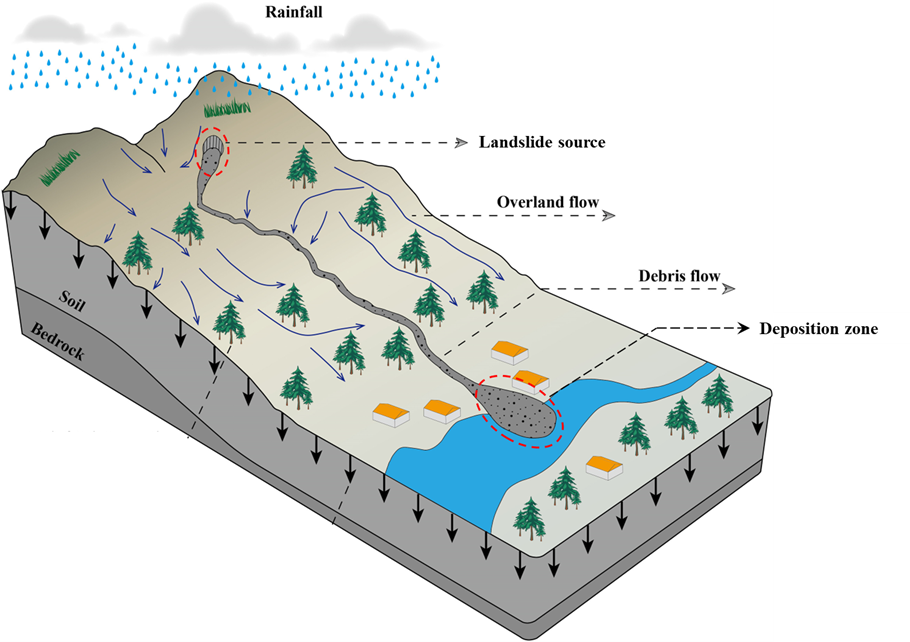
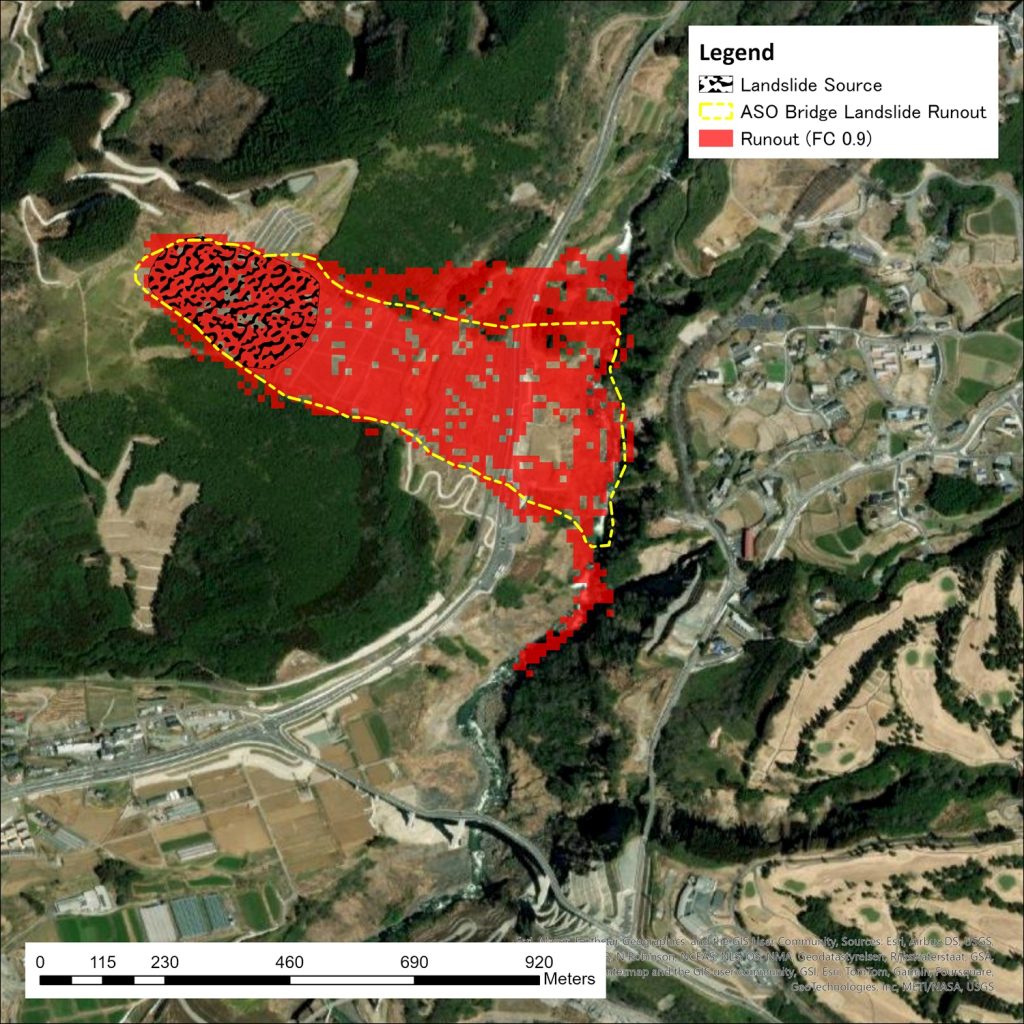
Debris flows are rapid, destructive landslides that pose significant risks in mountainous regions. This study presents a novel algorithm to simulate debris flow dynamics, focusing on sediment transport from 0-order basins to depositional zones. The algorithm integrates the D8 flow direction method with an adjustable friction coefficient to enhance the accuracy of debris flow trajectory and deposition modeling. Its performance was evaluated on three real-world cases in the Otoishi River basin, affected by rainfall-induced debris flows in July 2017, and the Aso Bridge landslide triggered by the 2016 Kumamoto Earthquake. By utilizing diverse friction coefficients, the study effectively captured variations in debris flow behavior, transitioning from fluid-like to more viscous states. Simulation results demonstrated a precision of 88.9% in predicting debris flow paths and deposition areas, emphasizing the pivotal role of the friction coefficient in regulating mass movement dynamics. Additionally, Monte Carlo (MC) simulations enhanced the identification of critical slip surfaces within 0-order basins, increasing the accuracy of debris flow source detection. This research offers valuable insights into debris flow hazards and risk mitigation strategies. The algorithm’s proven effectiveness in simulating real-world scenarios highlights its potential for integration into disaster risk assessment and prevention frameworks. By providing a reliable tool for hazard identification and prediction, this study supports proactive disaster management and aligns with the goals of sustainable development in regions prone to debris flow disasters.
Journal name
Geosciences
Relevant SDGs
SDGs 9: Industry, Innovation, and Infrastructure; 11: Sustainable Cities and Communities; 13: Climate Action; 15: Life on Land
Comments
This study introduces an innovative algorithm to enhance debris flow modeling and risk assessment, with applications in 0-order basins. By integrating Monte Carlo simulations and an improved D8 flow direction method, the research achieves high accuracy in predicting debris flow paths and deposition zones, validated through real-world case studies. The results underscore the potential of this approach to support disaster risk reduction and sustainable management in regions prone to landslide hazards.
Figure 11 (a–c): The debris movement from the source to the depositional zone:
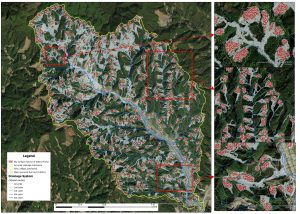
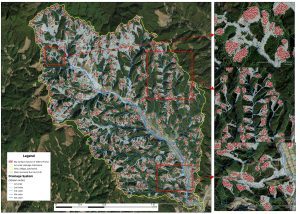
(a) A friction coefficient of 0.0001 applied (b) A friction coefficient of 0.5 applied
with 2 m of mass moving from the source. with 2 m of mass moving from the source.
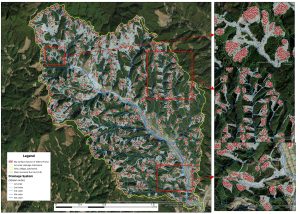
(c) A friction coefficient of 0.9 applied
with 2 m of mass moving from the source.