We asked the two students who were selected for FY2025-26 Integrated Research Project about various aspects of the project. Please take a look!
【Researcher Name】
SAKURAI Yusuke (Graduate School of Bioresource and Bioenvironmental Sciences, Department of Bioresource Sciences, D2)
Research Title in the doctoral program : Elucidation of intercellular bridge (ICB) fragmentation regulatory mechanism during mouse spermatogonia differentiation
TAKIUE Sena (Graduate School of Science, Department of Urban Design, Department of Chemistry, D2)
Research Title in the doctoral program : Interaction of lipid bilayers with amphiphilic peptides
【Integrated Research Title】
Artificial Manipulation of Cell Mobility and Establishment of Methods to Restore Cell Proliferation for Improving Cell Culture Efficiency
【Research Abstract】
This study focuses on cell membrane fluidity and aims to control it through artificial manipulation and to establish highly efficient culture conditions. Using various proliferative cells, we will create model membranes composed of phospholipids and cholesterol, and analyze membrane fluidity and domain structure using fluorescence spectroscopy. Based on the resulting findings, we will optimize culture conditions and identify genes involved in proliferative changes, with the goal of applying these findings to the fields of regenerative medicine and cell engineering.
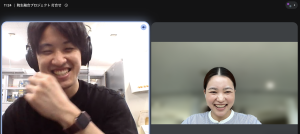
(Left) SAKURAI Yusuke (Right) TAKIUE Sena
Q1. What prompted you to start this joint research?
It all began when we met on last year’s AI-based cross-disciplinary course and became interested in each other’s research. Sakurai analyzes cellular behavior—such as cell proliferation and adhesion—from a molecular biological perspective, while Takiue focuses primarily on analyzing the deformation dynamics of model membranes in response to external stimuli (antimicrobial peptides) from the perspectives of colloidal interface chemistry and physical chemistry. Both researchers share a common focus on “membrane behavior.” We decided to conduct this joint research because we believed that by leveraging the strengths of each other’s work, we could compensate for the areas where the other was lacking—such as Sakurai’s focus on molecular-level analysis and Takiue’s emphasis on practical applications—and conduct research from a multifaceted perspective.
Q2. How did you feel about being selected for the Integrated Research Project?
(Sakurai) As this was the first time I’d been awarded research funding, I felt one-quarter surprise and three-quarters joy. I had no prior experience with research focusing on cell membrane lipids, so I found myself looking forward to the project a bit.
(Takiue) I am truly honored. I believe this is a unique initiative of SPRING that allows students from different fields to conduct research together, so I am very grateful for this invaluable opportunity. Furthermore, since my research is basic —involving experiments and analysis at the molecular level, which is quite microscopic—I am delighted to have the chance to collaborate with someone like Mr. Sakurai, who is engaged in more practical research.
Q3. What is the current progress of your joint research?
We are currently analyzing the composition of the cell membrane of our target cells, depending on their state, as well as fluctuations in the associated genes. Based on the above analysis results, we plan to create model membranes with simplified structures and compositions and analyze, at the molecular level, how membrane fluidity and miscibility affect the rate of cell division and other processes.
Q4. What new “insights” have you gained while conducting joint research?
(Sakurai) I realized that the pace of our research is quite different. Since I have to wait for the organisms (mice) to grow, prepare samples from them, and then begin the experiments, my research schedule typically ranges from a week at the shortest to around eight weeks at the longest. Ms. Takigami, on the other hand, can carry out her experiments within a timeframe of around three days at the shortest and two weeks at the longest.
(Takiue) I was surprised to learn that there are various experimental methods for analyzing the cell membranes of actual organisms. It’s not just a matter of collecting and analyzing cell membranes; there are also methods like predicting their composition based on genes, and I’m learning so much from all of this.
Q5. What are some of the difficulties of joint research that you did not think of when you were planning (applying for) this project?
(Sakurai) It was difficult to manage the consumption and procurement of reagents and other supplies, as well as the allocation of research funds, given the varying pace of each research project.
(Takiue) I’m finding it challenging to work with actual living organisms rather than model systems. Since I primarily conduct experiments using synthetic reagents, I can schedule my experiments according to my own schedule; however, in Mr. Sakurai’s research, the experiments are highly dependent on factors such as the growth rate of living organisms, so I find it difficult to carry out the experiments. Furthermore, since actual cells are quite complex systems, I find that even analyzing the lipid composition of the cell membrane alone is more difficult than I had imagined.
Q6. What is the reaction of your academic advisors and the members around you in the lab?
(Sakurai) My supervisor is very pleased with my work, and I keep him updated on the progress of my research and consult with him as and when necessary. When we students have trouble deciding on our own how to proceed with our research or what direction to take, we consult with our academic advisor and seek their opinion.
(Takiue) Each of my advisors has been providing me with various forms of support, including guidance on conducting experiments. I also hope that by collaborating with researchers from other fields to conduct more practical experiments, I can inspire my lab members—perhaps making them realize, “So this is how the basic research I’m doing can be useful!”
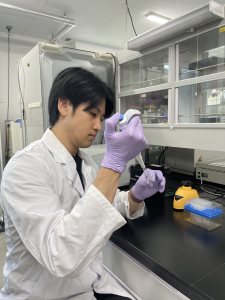
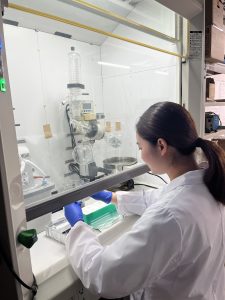
Q7. How do you actually conduct this joint research?
When drafting the project application, we met in person at the Science Library to discuss its contents. Since the project was approved, we have been holding monthly online meetings to report on our respective analysis results. In addition, we use Slack to share experimental results as needed.
Q8. How did you spend your research budget? What could you do/what would you like to do if you had another research budget?
Currently, our research budget is primarily used to cover reagents and equipment for analyzing cell membrane composition, fabricating model membranes, and analyzing molecular distribution within membranes. As we advance, we plan to use the budget for reagents, equipment, and facility usage fees related to analyzing cell membrane fluidity and miscibility. If we are able to secure additional funding, we would like to conduct a more detailed analysis of the cell membrane phospholipid composition using LC-MS/MS. However, the columns required for this are extremely expensive, and we are currently still discussing whether to purchase them. Furthermore, if any companies or other organizations are interested, we would like to use the funds for joint research projects.
Q9. Do you think there is a good chance of presenting this joint research at a conference or writing a paper? What percentage do you think there is?
At present, I estimate that 50 percent of my work will involve conference presentations, whilst less than 5 percent will be devoted to writing papers. During the grant period, I would like to gather enough data to be able to present at a conference.
Q10. What are your future prospects and aspirations for this joint research?
We hope to uncover a novel relationship between changes in cell membrane composition resulting from fluctuations in gene expression—which depend on the state of the cells—and the membrane’s fluidity. Since we are conducting our research using actual cells, this may be a challenging topic, but the two of us will work together and do our very best.
Q11. What are your dreams for the future and what kind of person do you both aspire to be?
(Sakurai) I aim to become a researcher who is both versatile and highly specialized.
(Takiue) While building on my expertise as a strength, I want to become a researcher who can approach issues from various perspectives, interact with researchers in diverse fields, and make a contribution both in Japan and around the world.
Q12. Please leave a message for the program students who follow to take on the challenge of the Integrated Research Project and joint research.
(Sakurai) I feel that K2-SPRING helps you find researchers who can turn your ideas into reality. Collaborative research with students and researchers from other fields provides an excellent opportunity to reassess the strengths and weaknesses of your own research. It also enables you to gain a broader understanding of other disciplines. As research funding will not be awarded unless you apply, I encourage you to apply for the Interdisciplinary Postgraduate Program alongside students willing to collaborate on your ideas, intending to secure research funding.
(Takiue) As you pursue your research, there may be times when you feel stuck. However, by interacting with researchers from other fields, you’ll gain knowledge not only in your own specialty but also in other disciplines, which will significantly broaden your horizons and may lead to unexpected insights from different perspectives. I believe that understanding issues from various perspectives and acquiring knowledge are skills that will be extremely valuable both in your own research and later in your career. I think it’s truly a privilege to have opportunities like these as a student, so I encourage you to give it a try!