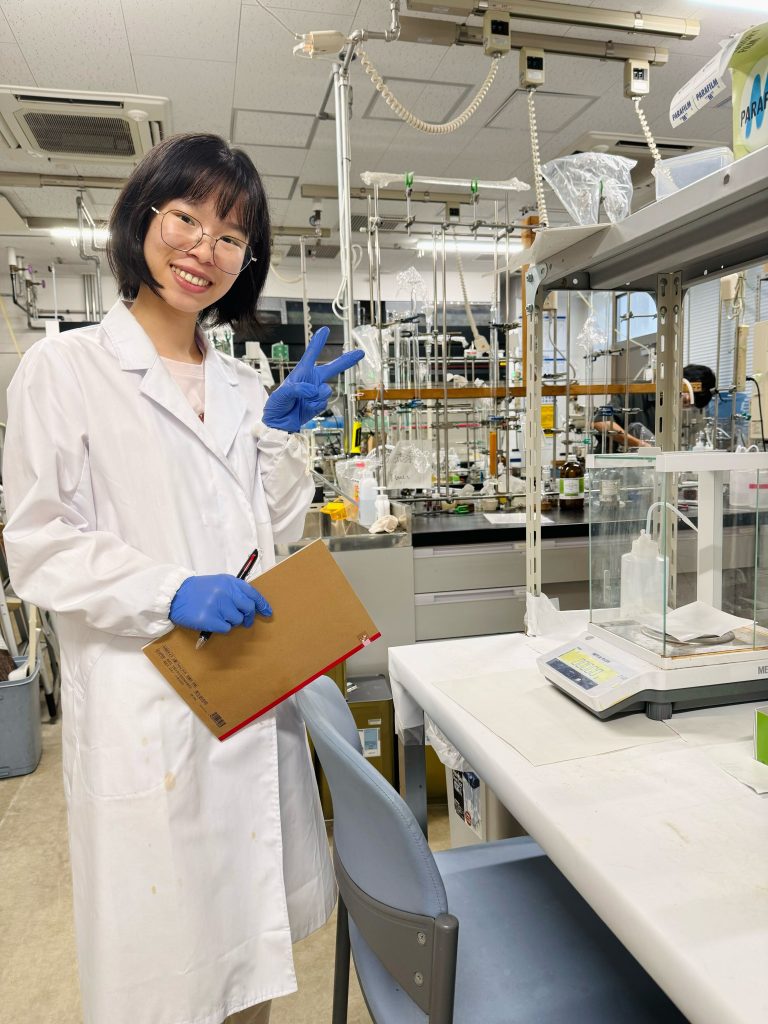
LIAO CHEN’s (Graduate School of Science) paper has been accepted for ACS Catalysis.
Congratulations!
Chen Liao, Kosei Yamauchi, and Ken Sakai
Department of Chemistry, Graduate School of Science
Mechanism of Ni-NHC CO2 Reduction Catalysis Predominantly Affording Formate via Attack of Metal Hydride to CO2
The catalytic role of the hydride intermediate in the reduction of CO2 to formate (HCOO–) by Ni(II)-NHC complexes is investigated in detail by density functional theory (DFT) calculations. It is found that a Ni(II)-hydride is sufficiently hydridic to facilitate the efficient transfer of hydride to the carbon center of CO2, leading to HCOO– production. Importantly, the direct hydride transfer path proposed here bypasses the conventional insertion of CO2 into a metal–hydride bond. This mechanism is elucidated through a detailed analysis of the free energy changes and activation barriers, where key parameters, such as reduction potentials, pKa values, and thermodynamics of the catalytic processes, are thoroughly evaluated. The thermodynamic hydricity of the Ni(II)-hydride, calculated to be ΔG°H– = 19.2 kcal/mol, is in sharp contrast with the less effective Ni(III)-hydride with ΔG°H– = 52.4 kcal/mol, highlighting the enhanced reactivity of NiII-hydride in formate formation. Additionally, an examination of the competitive formation of CO and H2 reveals the preferential tendency of Ni(II)-hydride to produce HCOO– over these byproducts. Insights into the influence of pKa for the proton source on the feasibility of H2 production and formate selectivity are also provided, suggesting a way to optimize reaction conditions for improved selectivity and efficiency. Our findings provide a comprehensive understanding of the reduction of CO2 to HCOO– by Ni(II)-NHC catalysts, emphasizing the direct hydride transfer mechanism rather than the classical CO2 insertion mechanism.
ACS Catalysis, Volume 14, Issue 14
SDGs 13 (CLIMATE ACTION)
Comments