K²-SPRING alumnai Bo Li’s paper has been accepted for IEEE Photonics Technology Letters.
Congratulations!
Authors
Bo Li, Ming Che, Shenghong Ye, Yuya Mikami, Kazutoshi Kato
Affiliation
Graduate School of Information Science and Electrical Engineering, Department of Electrical and Electronic Engineering
Manuscript Title
Demonstration of Optoelectronic THz Beam Tracking Using Real-time Phase Optimization
Abstract
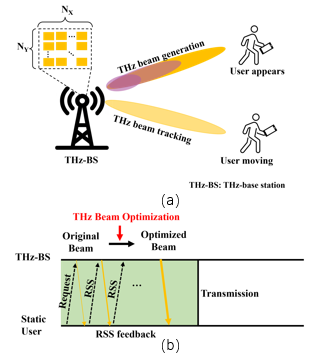
Addressing the critical beam alignment challenge in Terahertz (THz) communications for 6G, this letter details the implementation of 300 GHz beam tracking using an arrayed antenna. Despite the efficiency of beamforming, narrow THz beamwidth demands precise alignment. Our system uniquely combines an optical phased array with a real-time algorithm that optimizes the beam direction based on received power feedback. We experimentally validated the system’s effectiveness. First, successful static beam optimization was demonstrated, achieving a synthesis gain of 11.5 dB, which approaches the theoretical limit. Furthermore, beam tracking was achieved for a receiver moving within an angular range of ±40° at angular velocities up to 3.58 deg/s. Throughout the tracking process, the arrayed antenna demonstrated a stable mean synthesis gain of 9.11 dB. This successful demonstration provides a viable pathway to enhance the robustness and efficiency required for future THz mobile communication networks.
Journal name
IEEE Photonics Technology Letters
Relevant SDGs
SDGs 9 (Industry, Innovation, Technology and Infrastructure)
Comments
This work shows that OPA-based optoelectronic control can effectively manage narrow beams in the THz range. The demonstrated tracking capability offers a promising approach for practical, high-performance mobile communication systems needed for future 6G networks in the THz band.