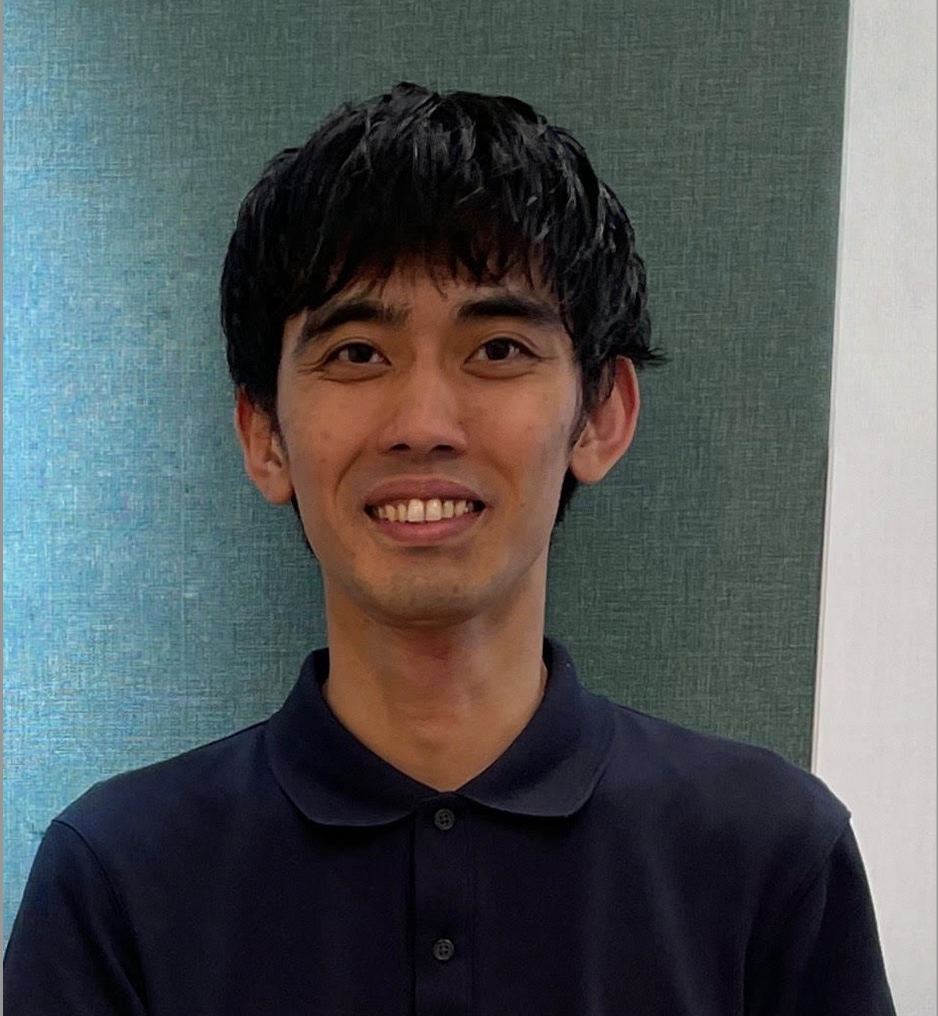
Mr. Akira Shiozuka
Tokyo Electron Kyushu Limited
2016 Bachelor’s Degree in International Development Engineering,
Tokyo Institute of Technology
2018 Master of Science in Chemistry,Tokyo Institute of Technology
2020 Admitted to the Doctoral Program in Molecular and Material Sciences,
Interdisciplinary Graduate School of Engineering Sciences,Kyushu University
2021 Started receiving SPRING Program support
2023 Completed Ph.D. Program in Department of Molecular and Material Sciences,
Interdisciplinary Graduate School of Engineering Sciences, Kyushu University
2023 RIKEN Molecular synthesis and Function Laboratory, Postdoc
2025 Tokyo Electron Kyushu Limited, Process Technology Department
To this day
▷Affiliation While Enrolled in the SPRING program
Interdisciplinary Graduate School of Engineering Sciences,
Department of Molecular and Material Sciences
▷What motivated you to pursue a doctoral program? Please share the thoughts or experiences that led to your decision.
My decision to pursue a doctoral program did not stem from a single, clear-cut reason. At the time I was considering further study, I had a vague but persistent desire to devote myself to fundamental research until I felt genuinely satisfied with the depth of my understanding. Meanwhile, I was already employed in industry, and I found myself torn between continuing my career as a corporate employee and returning to academia to focus on research. After much reflection, I concluded that pursuing a Ph.D. while I was still young—and while I still had the flexibility to make major life choices—would leave me with fewer regrets in the future. This ultimately led me to commit to the doctoral path.
▷Among the experiences, skills, and networks you gained during your doctoral studies, which ones do you feel have been particularly useful in your current career?
During my doctoral studies, I pursued not only my core discipline of organic chemistry but also ventured into areas such as photochemistry and quantum computational chemistry in order to deepen my understanding of the research problem. Although the process involved constant trial and error, it allowed me to develop the ability to think more broadly and from multiple perspectives.
I am now working in a field quite different from my academic specialization—semiconductor manufacturing—and I devote myself every day to acquiring new knowledge and practical expertise. The experience of working across multiple scientific domains during my Ph.D. has been invaluable; it enables me to approach challenges with perspectives unique to someone entering from a different field. Thanks to this, I am able to stay positive and engaged in my work, and each day feels intellectually stimulating and rewarding
▷What challenges or difficulties did you face during your doctoral studies? Please tell us how you overcame them.
In my field of organic chemistry, I spent six months working on the development of a particular reaction. Despite my efforts, I was unable to achieve the results I had hoped for, and it was an emotionally difficult period for me. Even in such circumstances, I tried not to push myself too hard; instead, I intentionally shifted my mindset by exploring reactions I had long wanted to try or new ideas that came to mind. This helped me stay connected to the enjoyment of experimentation.
I was also fortunate to receive both scientific guidance and emotional support from my supervising professor. Thanks to that support, I was able to continue engaging with my research without becoming overly discouraged.
▷How did obtaining your Ph.D. and participating in the SPRING program influence your perspective on your career and your approach to research?
To broaden and deepen my research, I have always valued looking beyond the boundaries of my own specialization and integrating perspectives from other fields. During my doctoral studies, I encountered challenges that could not be fully addressed through organic chemistry alone. By incorporating ideas from photochemistry and quantum computational chemistry, I was able to move my research forward in meaningful ways.
These experiences helped me develop an open-minded and flexible approach—one that welcomes different disciplines rather than being constrained by them. I continue to apply this mindset in my current development work, where I make a conscious effort to maintain a balanced, unbiased perspective as I tackle new challenges.
▷Please share a message or advice for junior students who are considering pursuing a doctoral program or applying to the SPRING program.
Although this is just my own experience, looking back on my doctoral studies, there were many moments when I struggled both physically and mentally on the path to completing my Ph.D. At the same time, it was also an invaluable period during which I was able to immerse myself in research that genuinely fascinated me and to deepen my work through active discussions with my advisors.
As a result, I was able to contribute to cutting‑edge science in the form of peer‑reviewed publications, which made my research experience truly fulfilling. For anyone who has a strong desire to thoroughly explore a research topic that interests them, I believe that pursuing a doctoral degree can be a uniquely rewarding and irreplaceable experience.